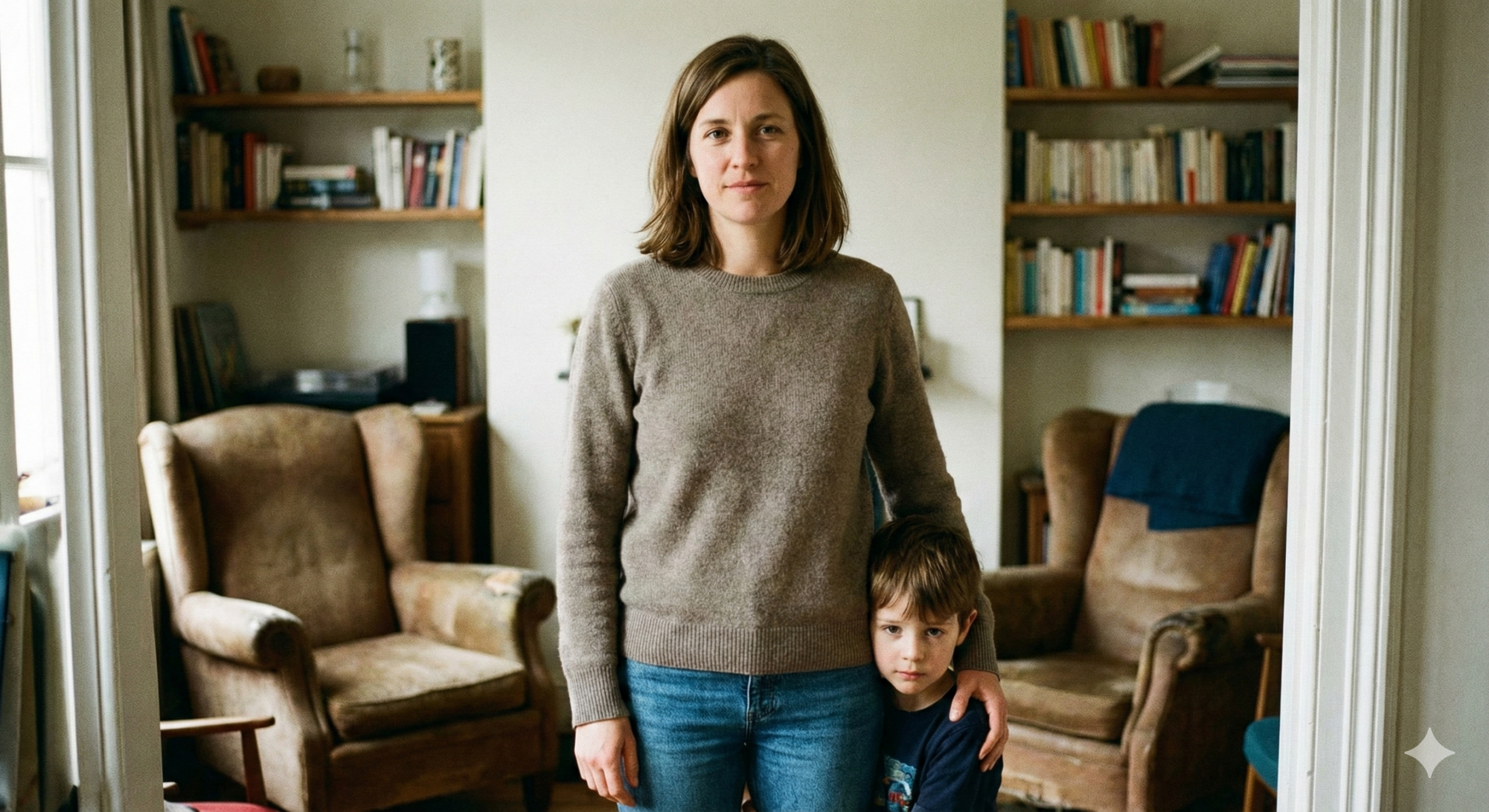
This is a story about the kind of silence that falls right before an explosion. It’s a story about the lies families tell themselves to justify cruelty, and the terrifying power of the truth when it finally drops.
My aunt, Beatrice, always believed that wealth was a character trait. If you had it, you were virtuous. If you didn’t, you were defective. For years, I watched her apply this morality test to everyone who entered our family orbit. She was the gatekeeper, the assessor, the one who decided who was worthy of a seat at the mahogany table and who belonged in the kitchen folding napkins.
When I brought Leo home, I knew exactly where Beatrice would place him.
Leo was seven years old, with eyes too big for his face and a habit of flinching if you moved your hand too fast. He had entered the foster system six months earlier after a car accident wiped out the only world he’d ever known. When he landed on my doorstep, he came with a black garbage bag containing two t-shirts, a worn-out plush dinosaur, and a profound, heavy silence.
It took three months for him to speak above a whisper in my house. It took four months for him to let my husband, Ben, read him a bedtime story. We were slowly, painstakingly rebuilding a sense of safety for a child whose foundation had been shattered.
Then came Christmas.
My family’s Christmas Eve gathering was an institution. It was held at Aunt Beatrice’s sprawling suburban estate, a house where the coasters were made of marble and the towels were folded in ways that made you afraid to dry your hands. It was a performance of prosperity, loud and aggressive.
I hadn’t wanted to go. I knew Leo wasn’t ready for the sensory overload of Beatrice’s shrieking laughter and the competitive gift-giving of my cousins. But my mother had guilt-tripped me.
“It’s Christmas, Clara,” she’d pleaded on the phone. “Beatrice is already saying you think you’re too good for us since you married Ben and started doing your… charity work. Just come for an hour. Show face. For me.”
My “charity work” was being a social worker. Ben was a public defender. In Beatrice’s eyes, we had chosen poverty, which was practically a criminal offense.
Against my better judgment, we went.
I prepped Leo for days. We talked about how loud it would be, how many people would be there. I told him he could squeeze my hand three times if he needed a break, and we would immediately go sit in the car.
“Will Santa know I’m there?” he had asked quietly the night before, clutching his dinosaur.
“Santa knows exactly where you are, buddy,” Ben had promised him.
When we walked into Beatrice’s house, the air smelled of expensive pine candles and roasting meat. The tree in the great room was twelve feet tall, groaning under the weight of heirloom ornaments and hundreds of twinkling lights. But the real spectacle was underneath it.
The presents weren’t just stacked; they were landscaped. Mountains of silver and gold wrapping paper, towering piles dedicated to Beatrice’s grandchildren—my cousins’ kids, who were charming, loud, and spoiled rotten. They were already running laps around the tree, vibrating with sugar and anticipation.
Leo stuck to my leg like a burr. I felt his small hand trembling against my jeans.
Beatrice swooped down on us in a cloud of heavy perfume. She was wearing a red velvet dress that probably cost more than my car.
“Clara! You made it.” She offered her cheek for a kiss, her eyes already darting over my shoulder to inspect Ben’s off-brand sweater. Then, her gaze lowered to Leo.
Her smile didn’t just drop; it evaporated.
“And this is… the foster boy,” she said. Not ‘Leo.’ Not ‘your son.’ The foster boy. Like he was a temporary appliance we were renting.
“This is Leo, Aunt Bea,” I said, keeping my voice level. I squeezed Leo’s shoulder. “Leo, this is my Aunt Beatrice.”
Leo managed a tiny, jerky nod. He didn’t make eye contact.
Beatrice sniffed. “Well. Don’t let him touch the ornaments on the lower branches. They’re vintage German glass.”
She spun around and marched back toward the kitchen before I could respond. I felt Ben bristle beside me.
“One hour,” I murmured to him. “We can do one hour.”
We navigated the party like we were walking through a minefield. My cousins offered polite, strained greetings, asking questions about fostering that felt more like an interrogation. Was he violent? Did he steal? Wasn’t I worried about my nice things?
Leo sat sandwiched between Ben and me on a stiff brocade sofa, his feet barely reaching the edge of the rug. He watched the other children play with a detached sort of wonder, like he was watching a nature documentary about a different species.
Finally, the main event arrived. Gift time.
It was organized chaos. Beatrice sat in a high-backed armchair like a queen on a throne, directing the distribution of presents. Names were called out. Wrapping paper flew. The sounds of shrieking delight filled the room as my cousins’ kids unwrapped iPads, designer clothes, massive Lego sets, and drones.
The piles dwindled. The floor became a sea of discarded paper.
Leo sat perfectly still. He wasn’t expecting anything. That was the heartbreaking part. He had learned early in life that good things happened to other people. He was just an observer.
But I expected something.
I had sent Beatrice a polite text three weeks ago. I didn’t ask for much. I just mentioned that Leo was obsessed with space and dinosaurs, in case she wanted to get him a little something to open along with the other kids. Just so he wouldn’t be the only one sitting there empty-handed.
I watched the pile disappear. I watched the last few gifts being handed out to distant relatives.
Nothing for Leo.
My stomach began to churn with a familiar, hot acid. I looked across the room at my mother. She caught my eye and quickly looked away, busying herself with her wine glass. She knew.
I waited until the frenzy died down. The other kids were already deeply engrossed in their new expensive toys. The silence in the room was the satisfied quiet of consumers who had been sated.
I stood up, taking Leo’s hand. I walked over to where Beatrice was holding court near the fireplace, accepting praise for her generosity.
“Aunt Beatrice,” I said. The room quieted down. My voice wasn’t loud, but it had a tremor in it that I couldn’t suppress.
She looked up, swirling her brandy snifter. “Yes, Clara? Leaving so soon?”
“I just wanted to check,” I said, trying desperately to keep the wobble out of my voice for Leo’s sake. “Did something get misplaced? I don’t see anything for Leo under the tree.”
The silence in the room changed then. It went from satisfied to sharp. My cousins stopped talking. My mother stared fixedly at the carpet.
Beatrice didn’t even blink. She took a slow sip of her brandy.
“Oh, Clara,” she said, with a sigh that suggested I was being terribly tiresome. “Don’t be gauche.”
“Gauche?” I repeated. “I’m asking why the seven-year-old boy standing right here is the only child in this house who didn’t get a Christmas present.”
Beatrice set her glass down with a sharp click on the marble coaster. She turned her body fully toward me, her eyes hard little stones.
“We talked about this, Clara. With your mother.”
I looked at my mother. She was pale, refusing to meet my gaze.
“Talked about what?” I demanded.
Beatrice waved a hand dismissively toward Leo, who was shrinking behind my legs, trying to make himself invisible.
“We don’t know how long he’s going to be here,” Beatrice said loudly. The words seemed to echo off the high ceilings. “He’s not family, Clara. He’s a project. A temporary arrangement.”
“He is a child,” I whispered, horrified.
Beatrice stood up, towering over us. “Listen to me. I spend a great deal of money on these gifts. They are for my grandchildren. My blood. We are not going to start setting a precedent of buying expensive things for every stray you decide to drag through here to make yourself feel virtuous.”
And then, she delivered the line. The one that would ring in my ears for days.
She looked directly at Leo, curled her lip in distaste, and said:
“We don’t buy gifts for charity cases.”
The room absolutely froze. You could hear the pine needles drop onto the tree skirt.
I felt Leo flinch against my leg so hard it nearly knocked me off balance. I looked down. His face was completely blank. The light had gone out of his eyes. He wasn’t surprised. He was just… confirmed. He was exactly what he feared he was. Disposable.
The rage that hit me was unlike anything I had ever felt. It wasn’t hot; it was absolute zero. It was a cold, clarifying fury that sharpened my vision and slowed my heart rate.
Ben was standing up, his fists clenched at his sides, ready to tear the room apart. I put a hand on his chest to stop him.
“Okay,” I said. My voice was terrifyingly calm. “Okay, Beatrice. I understand perfectly.”
I looked around the room at my family. My mother, still staring at the floor. My cousins, pretending to be fascinated by their children’s new iPads. Not one of them spoke. Not one of them looked at the small boy whose heart had just been publicly broken.
“Come on, Leo,” I said softly. “Let’s go home. Santa came to our house, remember?”
I didn’t wait for goodbyes. We walked out of that mausoleum of wealth and greed, past the twelve-foot tree, past the mountains of torn silver paper.
We drove home in silence. Leo fell asleep in the backseat almost immediately, exhausted by the effort of existing in a hostile environment.
Ben reached over and took my hand. His knuckles were white. “I’m going to kill her,” he said flatly.
“No,” I said, staring straight ahead at the dark road. “You’re not. Because I’m going to do something much worse.”
Beatrice had made a calculation based on the information she had. She looked at me—a social worker in a five-year-old Honda—and she looked at Leo—a foster kid with a trash bag of clothes—and she saw zero value. She saw people she could crush without consequence because we had no power in her world.
But Beatrice didn’t have all the information.
She didn’t know about the paperwork sitting in a fireproof safe in my basement office.
She didn’t know who Leo really was.
Leo’s parents hadn’t just died in a car crash. They were brilliant, quiet people. His mother had been a software architect who got in on the ground floor of a company that is now a household name. His father was a bio-engineer holding several patents that are used in hospitals around the world.
They were the kind of rich that Beatrice couldn’t even comprehend. They weren’t loud rich. They didn’t buy velvet dresses or marble coasters. They lived in a modest house, drove Subarus, and put every spare cent into secured trusts and aggressive investment portfolios for their only son.
When they died without a will appointing a guardian, the state stepped in. Because the financial situation was so complex, it took months for the forensic accountants to untangle it. By the time they realized the staggering scope of Leo’s inheritance, he was already in the system, and I was his caseworker.
When I decided to foster him, I had to be read into the financial situation as his temporary guardian. I signed NDAs thick enough to choke a horse. The court was adamant: Leo was not to know the extent of his wealth until he was much older, for his own safety and normalcy. And nobody else was to know either, to protect him from exactly the kind of people my Aunt Beatrice was.
I was the sole trustee of the estate until he turned twenty-five.
I spent Christmas Day trying to repair the damage. We stayed in pajamas. Ben made pancakes shaped like dinosaurs. We opened our presents—a telescope, a pile of space books, a new winter coat that wasn’t a hand-me-down. Leo smiled, but it was a brittle, fragile thing. The shadow of Beatrice’s words hung over him.
By Boxing Day, the 26th, my rage hadn’t faded. It had solidified into a weapon.
I knew Beatrice. She couldn’t leave well enough alone. She was the type of narcissist who needed to smooth things over, not by apologizing, but by gaslighting you until you agreed that you were the one who overreacted.
Sure enough, at 11:00 AM, her Mercedes pulled into our gravel driveway.
I watched her walking up the path, holding a foil-covered plate. Leftovers. Her peace offering.
I met her at the door. Ben took Leo to the backyard to play on the swing set.
“Clara,” she breezed in as I opened the door, pushing past me into our small living room. She wrinkled her nose slightly at the worn armchairs. “I brought some prime rib. I know you probably didn’t have a proper Christmas dinner after running off like that.”
She set the plate on the coffee table and turned to me, putting on her best reasonable-adult face.
“Look, Clara. I know you’re upset. But you have to be realistic. You can’t expect us to treat every passing stray like family. It’s unfair to the actual grandchildren.”
I stood in the middle of the room, arms crossed. “He’s seven, Beatrice. He heard you call him a charity case.”
“Well, if the shoe fits,” she sniffed, adjusting a cuff on her cashmere sweater. “You and Ben mean well, but you’re bleeding hearts. You take on these burdens you can’t afford, and then you get mad when the rest of us don’t open our wallets to support your hobby. It’s tacky.”
My hobby.
“I need to get something from my office,” I said quietly. “Wait here.”
I went down to the basement. I opened the fireproof safe. I bypassed the adoption paperwork we were beginning to file. I reached for the thick blue folder at the back.
I pulled out a single document. It was the Quarter 4 consolidated statement for the Leo V. Sterling Revocable Trust.
I walked back upstairs. Beatrice was standing by our mantle, criticizing my dusting.
“Beatrice,” I said.
She turned. I held out the document.
“What’s this? An apology letter?” she sneered, taking it.
“No,” I said. “It’s clarity.”
She adjusted her reading glasses on the end of her nose. I watched her eyes scan the page.
I saw the exact moment it hit her.
Her breath hitched. Her eyes widened so far I thought they might pop out of her head. She physically staggered back a step, clutching the paper with a manicured hand that was suddenly trembling violently.
“This… this is a mistake,” she whispered. Her voice was unrecognizable. It was thin, reedy, terrified.
“No mistake,” I said, leaning against the wall.
Beatrice looked up at me, her face drained of all color. She looked back at the paper. She ran her finger under the final bold number at the bottom of the page.
TOTAL ASSETS UNDER MANAGEMENT: $84,342,091.12
Eighty-four million dollars.
“But… but he’s a foster kid,” she stammered, her brain unable to compute the data. “His parents… the car crash… they were nobodies.”
“They were brilliant, frugal nobodies who invented a component in the pacemaker that is currently keeping your husband alive, Beatrice,” I said coldly. “And they left everything to their son.”
Beatrice looked toward the back window, where Leo was swinging quietly, his breath puffing white in the cold air. The boy she had called a charity case less than forty-eight hours ago. The boy who was worth more than her entire immediate family combined, ten times over.
The transformation was instantaneous and sickening.
The sneer vanished, replaced by a grotesque mask of fawning concern. Her posture slumped from arrogant to ingratiating.
“Oh my god,” she breathed, pressing a hand to her chest. “Clara. Clara, why didn’t you say something?”
“Why would I?”
She took a step toward me, her voice dropping to a conspiratorial whisper. “Does… does your mother know? Does anyone know?”
“No. Just me. And the probate court.”
Beatrice’s mind was racing. I could practically hear the gears grinding as she recalculated Leo’s value in her world. Suddenly, he wasn’t a stray. He was a VIP. He was access. He was power.
“Well,” she said, a frantic smile stretching across her face. “This changes things, doesn’t it? We’ve been… oh dear, we’ve been terribly remiss.”
She looked back at the window, her eyes glittering with avarice. “That poor sweet boy. All that tragedy, and now all this… responsibility. He needs family, Clara. He needs people who understand wealth. People who can help guide him.”
She looked back at me, her eyes pleading. “You can’t do this alone, Clara. You’re a social worker. What do you know about managing this kind of estate? We need to bring him into the fold. Properly. I’ll throw another party. A New Year’s party. Just for him. We’ll get him everything. What did you say he liked? Space stuff? I’ll buy him a telescope. The biggest one they make.”
I watched her dance. I watched her shed her cruelty like an old skin the moment she smelled money. It was the most disgusting thing I had ever seen.
I walked over and gently pulled the statement out of her hand.
“You’re right, Beatrice,” I said. “I am just a social worker. Which is why I don’t manage the money. The bank does.”
I folded the paper.
“But I manage Leo. I am the sole legal guardian of his person and the sole trustee of his estate until he is twenty-five years old. Not my mother. Not you. Me.”
Beatrice’s smile faltered. “Yes, yes, of course. But we’re family. We help each other.”
“No,” I said. “You help people who have something you want. And yesterday, you decided Leo had nothing.”
“That was a misunderstanding!” she cried, reaching out to grab my arm. “I was stressed. The holidays…”
I stepped back, out of her reach.
“You called a traumatized seven-year-old boy a charity case to his face because you didn’t want to spend fifty dollars on a Lego set. You showed him exactly who you are. And now, I’m showing you who he is.”
I walked to the front door and opened it wide. The cold winter air rushed in.
“Get out of my house, Beatrice.”
“Clara, be reasonable!” she pleaded, her voice rising to a shriek. “Think of what we could do for him! The connections we have!”
“Leo doesn’t need your connections. He doesn’t need your marble coasters or your conditional love. He needs to know he matters even when he’s holding a trash bag of clothes. You failed that test. You’re done.”
She stood there for a moment, spluttering, her face turning a mottled shade of purple. The realization was sinking in. She hadn’t just been cruel; she had made a catastrophic financial error. She had alienated the richest person she would ever meet.
She walked out the door, defeated, clutching her cashmere cardigan around her like armor that had failed.
I closed the door. I locked the deadbolt.
I went into the kitchen and scraped the prime rib into the garbage disposal. I watched it grind away until there was nothing left.
Then I went outside. Ben was pushing Leo on the swing, higher and higher. Leo’s head was thrown back, and for the first time since Christmas Eve, I heard him laugh—a real, deep belly laugh that echoed in the cold air.
He didn’t know he was a millionaire. He didn’t know I had just cut the cancer of my family out of our lives. He just knew he was swinging, and someone was there to catch him when he came down.
That was the only wealth that mattered. And it was the only gift Beatrice could never buy.